Understanding Green, Yellow
& Red Trading Times

How market structure and trader psychology affect your results on the ASX
One of the most valuable skills you can develop as a trader is knowing not just what to trade, but when to trade. The ASX doesn’t offer the same quality of opportunity from the moment it opens to the moment it closes. Market conditions shift throughout the day and so does the psychology of the people trading in it.
There is a simple but powerful framework used by professional traders: Green, Yellow and Red Times. Understanding this framework will help you focus your energy on the right moments, protect yourself from unnecessary risk, and build the kind of consistent discipline that separates long-term traders from short-term gamblers.
Why Timing Matters
The ASX moves through very different phases and the quality of those phases varies significantly.
The market has moments of strong, directional movement where professional money is flowing, trends are clear, and your setups are more likely to work. It also has periods of noise and confusion where price moves look meaningful but aren’t and where inexperienced traders often get caught out.
What Drives These Different Phases?
Several forces shape how the ASX behaves throughout the day:
- Institutional activity: Large fund managers, superannuation funds and hedge funds tend to be most active at specific times. When they are buying or selling, price movement tends to be more purposeful and sustained.
- Algorithmic trading: Automated trading systems react to news, price levels and order flow. They are especially active at the open and close, which is part of why those periods can be volatile.
- Retail participation: Individual investors and traders also influence market behaviour. Emotional retail activity often peaks after a sharp move up or down, creating noise and false signals.
- Global market context: Overnight moves in the US markets (NYSE and NASDAQ) directly influence how the ASX opens each morning. A major move overnight can create a very different market environment compared to a quiet session.
- News and economic data: Company announcements, earnings reports and economic releases (such as inflation data or interest rate decisions) can dramatically change market behaviour at any time.Understanding these forces doesn’t mean you can predict what the market will do. But it does help you understand why the market behaves differently at different times and that understanding is the foundation of the Green, Yellow, Red framework.
Green Times
High-probability trading windows
Green Times are the periods of the trading day where the conditions are most favourable for executing your trading plan. This doesn’t mean every trade you take during a Green Time will be a winner. It means the environment is more conducive to reliable setups, cleaner price action and better risk management.
Think of Green Times as the windows where the signal-to-noise ratio is at its best where what the market is telling you is more likely to be real, rather than random.

What Makes a Green Time?
| Strong liquidity | More buyers and sellers are active, which means tighter bid-ask spreads and less chance of your order moving the price against you. |
| Institutional participation | Large, professional traders are actively positioning. Their activity creates more reliable trends and momentum. |
| Cleaner price action | Price moves in a more logical, structured way. Support and resistance levels are respected more consistently. |
| Confirmed direction | The market has had time to absorb news and find its footing. Trends are more established and easier to trade with conviction. |
| Better risk/reward | Cleaner moves mean you can place tighter stops and aim for more meaningful targets improving your overall trade quality. |
The Two Main Green Windows on the ASX
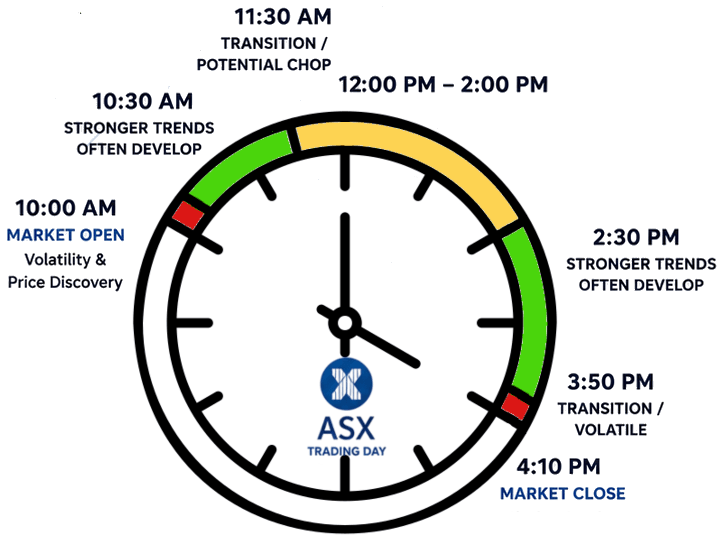
10:15am – 11:30am AEST The Morning Session
The first Green Time of the day typically begins around 15 minutes after the market opens, once the initial chaos of the open has settled.
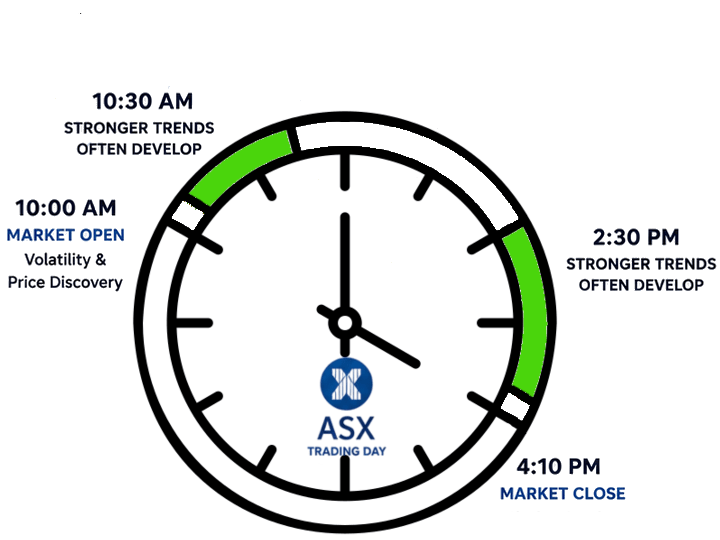
Here’s what happens in the lead-up to this window:
- The ASX opens at 10:00am, and the first 10–15 minutes are processed by algorithms reacting to overnight news and accumulated retail orders from the night before.
- By around 10:10am–10:15am, the opening imbalances start to clear.
- Institutional traders begin to execute their morning orders based on their overnight analysis.
- The market starts to establish a clearer direction for the day either continuing the previous day’s trend, or beginning a reversal.
During this window, experienced traders look for:
- Momentum continuation stocks or the index following through in the direction they opened.
- VWAP holds VWAP (Volume Weighted Average Price) is a key level that institutions use. Price holding above or below VWAP can signal strong directional intent.
2:00pm – 3:45pm AEST The Afternoon Session
The afternoon session is the second major Green Time on the ASX. After the quieter lunchtime period, liquidity often picks up again from around 2:00pm as a new wave of institutional activity begins.
This window is driven by several factors:
- End-of-day positioning fund managers and institutional traders begin adjusting their positions ahead of the close, often creating sustained directional moves.
- US pre-market activity as the Australian afternoon progresses, the US market is heading into its pre-market session. News from the US can begin influencing Australian stocks, particularly those with significant offshore exposure.
- Momentum continuation or reversal by the afternoon, the day’s major theme is often well-established. Strong trends from the morning session frequently continue, or a clear reversal may emerge.
- Repricing into the close as 4:00pm approaches, some stocks are repriced by market makers and institutional traders as they close out or establish positions for the next day.
Many professional traders actually prefer the afternoon session to the morning session. The market has had time to breathe, the noise of the open has long passed, and setups tend to be more deliberate and sustained.
Yellow Times
Caution zones trade selectively or step back
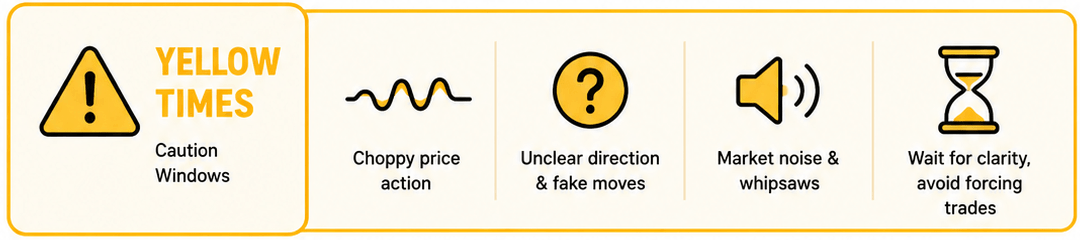
Yellow Times are not necessarily bad for trading but they require a higher level of caution, patience, and selectivity. These are periods where the market tends to be noisier, less directional, and more prone to trapping traders who are acting impulsively.
The analogy here is a traffic light. Yellow doesn’t mean stop it means slow down, pay attention, and proceed only if the conditions are right. During Yellow Times, the right response is often to reduce your activity, wait for clearer signals, and protect your capital.
Yellow Times

Caution zones trade selectively or step back
Yellow Times are not necessarily bad for trading but they require a higher level of caution, patience, and selectivity. These are periods where the market tends to be noisier, less directional, and more prone to trapping traders who are acting impulsively.
The analogy here is a traffic light. Yellow doesn’t mean stop it means slow down, pay attention, and proceed only if the conditions are right. During Yellow Times, the right response is often to reduce your activity, wait for clearer signals, and protect your capital.
12:00pm – 2:00pm AEST The Lunchtime Slowdown
The midday period on the ASX is often the quietest two hours of the trading day. Institutional traders have largely executed their morning positions and are taking a break. Retail participation slows. Volume dries up.
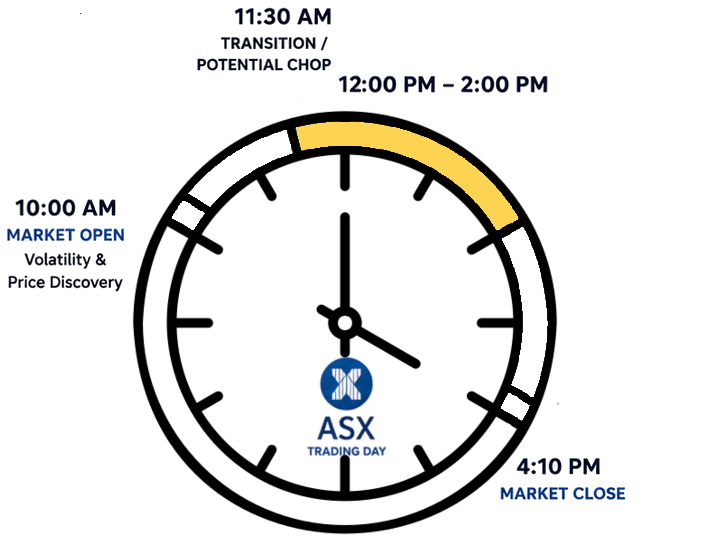
This creates its own set of challenges:
- Reduced liquidity fewer buyers and sellers in the market means wider spreads and the risk that your order will move the price more than expected.
- Random price movements with less volume driving price, even small orders can push prices around. Movements that look meaningful may simply be the result of a single buyer or seller with no broader market implication.
- False setups technical patterns that look like breakouts or reversals can form during lunchtime, only to fade or reverse when volume returns in the afternoon. A breakout on low volume is significantly less reliable than the same pattern on high volume.
- Spread widening in smaller stocks in small-cap and micro-cap stocks, the lunchtime period can see spreads widen considerably, making it more expensive to enter and exit.
The lunchtime period can feel frustrating when you’re eager to trade. The market is technically open, charts are moving, and it’s tempting to take any setup that appears. But the discipline to recognise low-quality conditions and to choose not to trade them is what separates consistent traders from those who chase every flicker of price movement.
How Professional Traders Use Yellow Times
Rather than trying to force trades during Yellow Times, experienced traders use these periods productively:
| Review open positions | Check your existing trades. Are stops in the right place? Is the thesis still valid? |
| Update watchlists | Identify stocks that are showing interesting setups for when Green Time resumes. |
| Analyse the morning session | What worked? What didn’t? What is the market telling you about today’s direction? |
| Check the broader context | What are futures markets doing? Is there any significant news expected this afternoon? |
| Reduce position sizes | If you do choose to trade during Yellow Times, consider using smaller position sizes to reflect the lower-quality conditions. |
| Rest and reset | Trading requires mental energy and focus. The lunchtime period is a natural opportunity to step away from the screen, clear your head, and return fresher for the afternoon session. |
Red Times
When discipline breaks down recognise it and stop
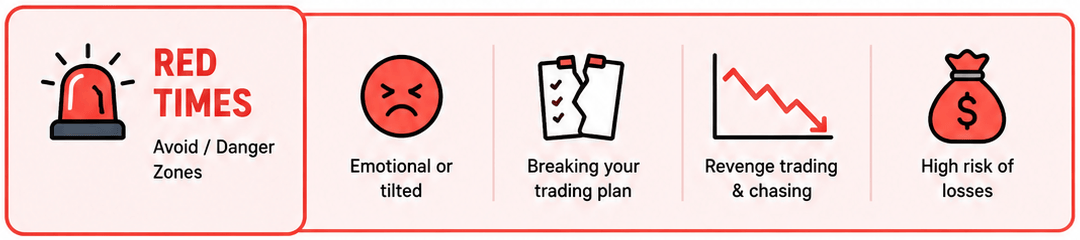
Red Times are the most important and most misunderstood part of this framework. Unlike Green and Yellow Times, which are primarily about clock time, Red Times are primarily about your mental state.
A Red Time is not something that happens to you based on what the clock says. It is something that happens inside you a shift in your psychology that begins to override your discipline, your process, and your rational thinking.
Here’s what makes this so important: you can enter a Red Time at 10:20am during a perfect Green window. You can enter a Red Time after your best trading day ever. Red Times are not about the market. They are about you.
10:00am – 10:15am AEST The Opening Volatility Window
The moment the ASX opens at 10:00am, something interesting happens: weeks of accumulated overnight orders are processed almost simultaneously, algorithms react to pre-market news in a fraction of a second, and the emotional energy of traders who have been waiting since yesterday’s close is unleashed all at once.
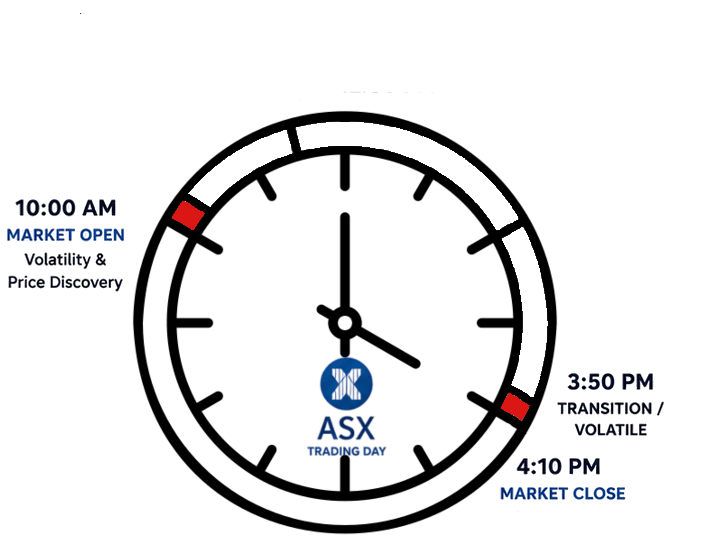
This creates a very specific kind of market behaviour:
- Fake breakouts price may spike sharply in one direction at the open, suggesting a strong move, only to immediately reverse. This is one of the most common traps for inexperienced traders.
- Wide bid-ask spreads with so many orders flowing at once, the difference between the buying price and the selling price can be much larger than normal, increasing your trading costs.
- Emotional reactions retail traders who see a sharp opening move often feel urgency to jump in quickly, which can exaggerate the initial move before reality sets in.
- Algorithmic whipsawing automated systems are buying and selling rapidly based on pre-programmed rules, creating sharp back-and-forth movements with little genuine directional intent.
The opening is exciting. It feels like the place to be. But many experienced traders will tell you that their worst trades have come from rushing to enter in the first few minutes of the session.
The discipline to wait to let the market find its footing and show you its hand is one of the most valuable skills you can develop.
What Causes Red Times?
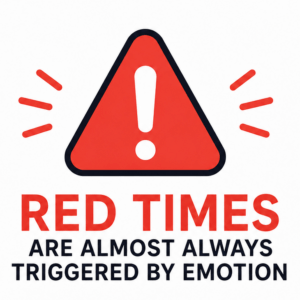
Red Times are almost always triggered by emotion. The most common triggers are:
A Losing Trade
A loss especially an unexpected or large one is the most common trigger for a Red Time. The emotional response to a loss is well-documented in behavioural psychology. We feel the pain of a loss approximately twice as intensely as we feel the pleasure of an equivalent gain. This is called loss aversion, and it is hardwired into human psychology.
The problem in trading is that loss aversion often drives us to do exactly the wrong thing. We want to make the loss ‘unhappen’ so we take another trade immediately, often with a larger position size, to try to win back what we lost. This is called revenge trading, and it is one of the most reliable ways to turn a small loss into a large one.
A Winning Trade
This one surprises many new traders. A big win can be just as psychologically dangerous as a big loss. After a strong win, you might feel invincible as though you have cracked the market. This overconfidence can lead to taking lower-quality setups, increasing your position size beyond what your plan allows, or abandoning your risk management rules entirely because you feel ‘ahead on the day.’
Professional traders know that no single trade win or lose should significantly change their approach to the next trade. Each trade is independent. The market doesn’t know or care how your last trade went.
Missing a Move
You identified a setup. You hesitated. The stock moved without you, and now it’s up 5%. The feeling of having missed a move sometimes called FOMO (Fear of Missing Out) can be intense enough to push traders into chasing stocks at extended prices, far from sensible entry points and with poor risk/reward ratios.
Experienced traders have a simple philosophy about missed trades: there will always be another setup. Chasing a move that you missed is one of the highest-risk things you can do in trading. The time to enter was before the move, not after it.
External Stress
Trading requires clear thinking and emotional stability. If you are dealing with significant personal stress whether financial, relationship-related, health-related or otherwise your decision-making capacity is compromised. Research consistently shows that stress reduces our ability to think rationally and increases our tendency toward impulsive behaviour. Trading while emotionally compromised is never a good idea.
The Warning Signs Recognising a Red Time
The difficult thing about Red Times is that when you’re in one, your own judgement is the least reliable it will be all day. That’s why it’s important to know the warning signs in advance, so you can recognise them even when your thinking is clouded.
| Impulsive entries | You’re entering trades without following your plan, without proper analysis, or ‘just because’ the price is moving. |
| Emotional after a loss | You feel angry, frustrated or desperate after a losing trade, and the urge to trade again immediately is strong. |
| Chasing missed moves | You’re considering entering a stock that has already made its move, in the hope it keeps going. |
| Breaking your rules | You’re ignoring your stop loss levels, increasing position sizes beyond your plan, or abandoning your entry criteria. |
| Focused on money, not process | Your internal dialogue has shifted from ‘is this a good setup?’ to ‘I need to make X dollars back.’ |
| Screen addiction | You can’t step away from the screen, and you feel anxious when you’re not watching the market. |
| Overtrading | You’ve taken far more trades than your plan calls for, and the quality of each successive trade has declined. |
The Psychology Behind the Framework
The Green, Yellow, Red framework is ultimately a tool for managing two things simultaneously: market conditions and your own psychology. These two things are deeply intertwined.
When market conditions are poor (Yellow or Red market conditions), they can trigger psychological Red Times in traders. And when you’re in a psychological Red Time, even a genuine Green window can become dangerous because your decision-making is compromised regardless of what the market is doing.

Why Professional Traders Often Trade Less
One of the most counterintuitive insights in professional trading is that the best traders are often not the most active traders. They trade less. They are more selective. And precisely because of that selectivity, their results are more consistent.
Here’s why: every trade you take has a transaction cost (brokerage), a spread cost (the difference between buying and selling prices), and an opportunity cost (your mental energy and capital that could be deployed elsewhere). A trader who takes 20 mediocre trades a day is paying those costs 20 times, for low-quality setups. A trader who waits for 3 high-quality setups a day pays those costs 3 times, for the best available opportunities.
Quality always beats quantity in trading.

Capital Preservation Is the Foundation
At Trade for Good, we believe strongly in a principle that many new traders underestimate: your capital is your most important asset. Without it, you can’t trade. Without the ability to trade, you can’t grow. Without growth, you can’t achieve the long-term financial and social goals that drive you to trade in the first place.
Every unnecessary loss every trade taken during a Yellow Time that didn’t need to be taken, every Red Time trade that cost you capital you didn’t need to risk is a direct cost to your future potential. Protecting your capital in bad conditions is not the same as being timid or fearful. It is intelligent, strategic, and professional.

Key Takeaways
Green Times Trade with confidence
- 10:15am – 11:30am and 2:00pm – 3:45pm are the primary Green windows on the ASX.
- During Green Times, market structure is cleaner, liquidity is stronger, and institutional activity provides more reliable direction.
- Focus on your highest-conviction setups. Be patient and let the trade come to you.
- Use VWAP, volume and price action to confirm the quality of your setup before entering.
🟡 Yellow Times Slow down and be selective
- 10:00am – 10:15am (the open) and 12:00pm – 2:00pm (lunchtime) are Yellow windows.
- Yellow Times are characterised by noise, lower liquidity, and unreliable signals. Patience is your edge.
- Use Yellow Times productively review your trades, update your watchlist, rest and reset.
- If you do trade during Yellow Times, reduce your position size to reflect the lower-quality conditions.
🔴 Red Times Stop, step back, and protect your capital
- Red Times are primarily psychological, not time-based. You can enter a Red Time at any point during the day.
- Common triggers include losses, unexpected wins, FOMO, overconfidence and external stress.
- Warning signs include impulsive entries, rule-breaking, revenge trading, and focusing on money rather than process.
- The moment you recognise a Red Time stop trading for the session. The market will be there tomorrow.
The Bottom Line
Successful trading is not about being in the market every minute of every day. It is about being in the right conditions, with the right mindset, executing the right setups.
The Green, Yellow, Red framework gives you a structure for making those judgements. Use it not as a rigid set of rules, but as a guide for developing your own self-awareness as a trader.

What you learn here has been used in our Trade for Good software.
Click on the button to find our software education videos.
You can read more of our educational articles in the Trade for Good Learn section
Trade for Good Learn