When a trade fills when,
can I expect the settlement?

This is an overview of once your trade has filled, when you will receive settlement or payment for the trade. The time when you can access the funds from a share sale can vary, read the guide below to learn more.
We are using the same scenario, but in this instance, you have SOLD 100 Commonwealth Bank (CBA.ASX) shares.
TIMEFRAMES SUMMARY
| Event | Time | Additional Details |
| Order placement | Instant | Dependent on your internet connection and platform responsiveness |
| Order routing | Milliseconds | Typically, 5-50 milliseconds from broker to exchange |
| Trade execution | Milliseconds – seconds | Market orders: near-instant; Limit orders: depends on matching |
| Trade confirmation | Seconds – minutes | You’ll see it on-screen within seconds, and formal confirmation within minutes |
| Broker confirmation notes | End of day (by 5pm) | Email sent containing complete trade details and contract note |
| Clearing (T+0 to T+2) | 2 business days | The background process is happening continuously |
| Settlement (T+2) | Morning of T+2 | Typically, between 8am-12pm AEST, coordinated batches |
| Money debited (buy) | T+2 (morning) | Deducted from your broker account or bank account |
| Money credited (sell) | T+2 or T+3 | Depends on broker policy; it may take an extra day to reach the bank |
| Bank transfer (if needed) | T+2 or T+3 | Additional time if transferring between banks |
| Share ownership legal | T+2 settlement | You become the legal owner upon settlement completion |
| Can sell purchased shares | T+2 onwards | Cannot sell until settlement completes (no short selling without margin) |
| Can receive dividends | Depends on ex-div date | Must own before the ex-dividend date, even if before T+2 |
| CGT 12-month period starts | Trade date (T+0) | Important for 50% CGT discount calculation |
| Trade appears on tax report | Financial year of T+0 | Even if the settlement occurs in the next financial year |
If those are the normal time frames, what are the exceptions?
SPECIAL SCENARIOS
T+2 Falls on Weekend/Holiday
Settlement automatically extends to the next business day.
Example 1:
- Trade Friday 21 Nov 2025 (T+0)
- T+2 = Sunday 23 Nov (non-business day)
- Actual Settlement = Monday 24 Nov 2025 (next business day)
- Your money is debited on Monday morning

Dividends
Key Rule: Entitlement is based on the ex-dividend date, not the settlement date.
Example:
- Ex-Dividend Date: 19 Nov 2025
- You buy: 18 Nov (T+0)
- Settlement: 20 Nov (T+2)
- You ARE entitled to the dividend (bought “cum dividend”)
- You sell: 20 Nov (T+0)
- Settlement: 22 Nov (T+2)
- You ARE still entitled to the dividend (sold “ex dividend”)
- Dividend Payment Date: 10 Dec 2025
- You receive the dividend even though you no longer own the shares
- Payment goes to whoever owned the shares on the record date (typically ex-div date + 1)

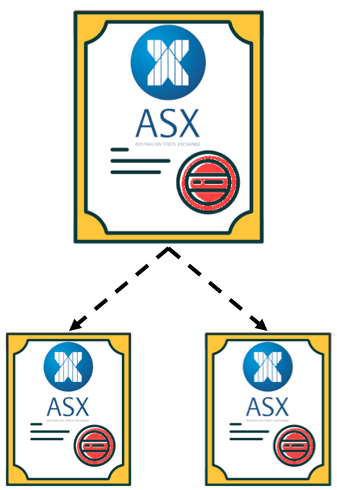
Share Splits
Example:
- Company announces 2-for-1 split
- Ex-Split Date: 25 Nov 2025
- You buy 100 shares: 24 Nov (T+0)
- Settlement: 26 Nov (T+2)
- You receive 200 shares (the split applies to your holding)
Rights Issues
Example:
- Rights Offer announced: 1 Nov 2025
- Ex-Rights Date: 15 Nov 2025
- You buy: 14 Nov (cum-rights – you get the rights)
- You buy: 16 Nov (ex-rights – you don’t get the rights)
- Rights Allocation: Based on holdings as of Record Date (16 Nov)
Important: If you sell after the ex-rights date but before settlement, you still receive the rights because you owned on the record date.
Takeovers
- If you buy during a takeover period, you receive the takeover offer
- If the scheme completion date falls before your settlement date, special rules apply
- Your shares may automatically be acquired by the bidder on the scheme date
- Proceed payment typically replaces share delivery in settlement

Common Settlement Questions

Q: Can I sell shares before T+2 settlement?
A: Yes, you sell shares you’ve purchased before they have settled (T+2). We cash vet orders, and monies associated with the buy are deducted from the available cash balance.
Q: What if I don’t have enough money on T+2?
A: Your broker will contact you. Options include: selling other holdings, borrowing from the broker (margin loan), or the broker may sell the shares on your behalf. Penalties and interest may apply.
Q: What happens if the seller doesn’t deliver shares?
A: ASX Clear guarantees the trade. They will find shares from other sources or buy in the market. The failing seller faces penalties and potential further consequences.
Q: Can I cancel a trade after execution?
A: Generally no. Once matched and executed, trades are binding. Exceptions exist only for clear errors acknowledged by the exchange (very rare).
Q: Do I pay tax on unsettled trades?
A: Tax obligations are based on trade date (T+0), not settlement date. If you trade on 30 June, it counts in that financial year even though settlement is in July.
Q: What’s the difference between my broker account and my HIN?
A: Your broker account is your trading and cash account with the broker. Your HIN is your ownership record in the CHESS system. Your HIN shows what shares you legally own.
Stockmarket Knowledge
This is one of the Stockmarket Knowledge Education articles, which delve into the processes and roles involved in online share trading on the ASX. It will show you who does what, why, when, and how monies are taken or paid during settlement.
Click on the subjects below to open the educational content.
The Bottom Line
Trade settlement on the ASX operates on a T+2 basis, meaning your trades legally complete two business days after execution. While you’ll see your order fill within milliseconds and receive confirmation almost immediately, the actual transfer of legal ownership and exchange of funds occurs 48 hours later through a coordinated process involving ASX Clear and the CHESS system.

What you learn here has been used in our Trade for Good software.
Click on the button to find our software education videos.
You can read more of our educational articles in the Trade for Good Learn section
Trade for Good Learn