Jack Dorsey called it an AI transformation.
But the data tells a different story.
In February 2026, Block — the company behind Square and Cash App — cut over 4,000 employees. Nearly half its workforce. Gone in a single announcement.
The stock jumped 22% overnight.
But to understand why this really happened, you need to go back to 2019.
The Hiring Surge Nobody’s Talking About:
In 2019, Block had 3,835 employees. By the end of 2022, it had 12,428. The company nearly quadrupled its headcount in three years.
It did not quadruple its revenue.
By the end of 2025, headcount still sat above 10,000.
And when challenged about it publicly, Dorsey didn’t hide from it. He admitted the company “over-hired during COVID,” saying part of the mistake came from running Square and Cash App as separate structures a setup that was corrected by mid-2024.
So let’s be clear about what we’re looking at:
This wasn’t AI making 4,000 jobs redundant overnight.
This was years of unchecked hiring, finally being unwound with AI as the framing.

The Stock Story:
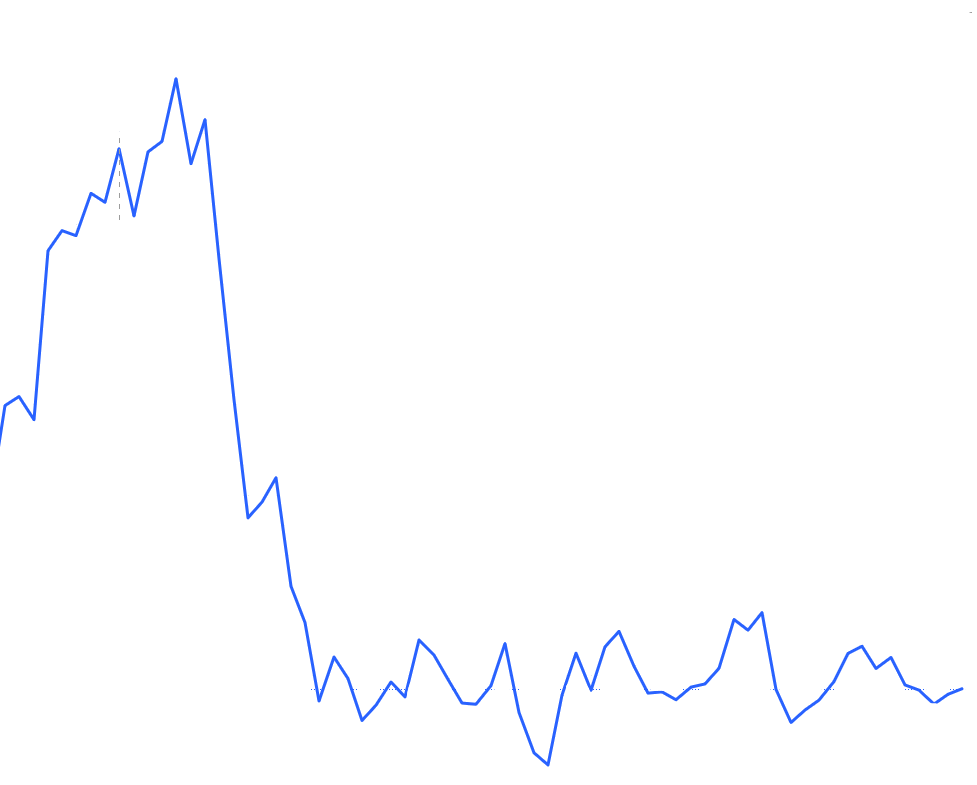
The stock chart tells its own story and it’s brutal.
Block’s stock rose from approximately $39 at its COVID low in March 2020 to an all-time high of $289 in August 2021. A staggering 640% rise in just 18 months.
Then came the crash. Pandemic-era growth stalled. The $29 billion Afterpay acquisition an acquisition Block is now quietly unwinding generated enormous write downs. The stock collapsed.
Block’s stock recovered somewhat from its 2023 lows but remained well below its 2021 peak of nearly $280 per share. Then, the moment 4,000 people lost their jobs? The stock surged 22%.
That’s the market signal every CEO just received.
The Efficiency Numbers:
Here’s the data point that cuts through all the AI narrative:
In 2019, each Block employee generated roughly $678,000 in gross profit. By 2022, after the hiring binge, that figure had declined to $482,000 meaning Block was generating less value per person despite massive revenue growth.
That’s not an AI problem. That’s a hiring discipline problem.
In total, Block eliminated more than 7,000 positions — over half its peak workforce — while gross profit nearly doubled from $7.5 billion to $10.4 billion.
The business was growing. The headcount just never should have been that large in the first place.

The AI Framing:
So why not just call it what it was — a correction of COVID-era over-hiring?
Because language matters enormously on Wall Street.
“We over-hired and now we’re fixing it” → Sounds like mismanagement.
“AI is transforming how we work and smaller teams can do more” → Sounds like vision.
Same outcome. Different language. Wall Street applauds.
To be fair, AI tools are genuinely part of the picture. Block’s internally built AI agent codenamed Goose has been in production for about 18 months, and since September, developer productivity improved with a 40% increase per engineer in pushing code and features to production faster.
But AI productivity gains and AI being the reason for 4,000 job losses are two very different things.

The Warning to Every Worker:
Dorsey told analysts: “Within a year, the majority of companies will reach the same conclusion.”
He’s not wrong but the conclusion he’s describing isn’t purely about AI capability.
It’s about a newly acceptable playbook:
→ Over-hire during boom times → Watch the stock soar → Correct the excess by cutting headcount → Frame it as innovation → Watch the stock soar again
Mass layoffs in the tech industry started in 2022, after a hiring surge during the pandemic, when demand for online services increased as people were stuck at home. But many of the world’s most powerful tech companies have continued cutting, even as their profits have grown.
Block is not an outlier. It’s the latest, most visible example of a pattern playing out across the entire industry.

The Question Nobody Is Asking:
If AI is genuinely making teams more productive and it is then who captures that value?
Right now, the answer is clear: Block’s shares jumped almost 20% following the earnings release and the announcement of the major workforce reduction, Shareholders won immediately.
The 4,000 people who lost their jobs? Affected U.S. employees will receive 20 weeks of base pay plus one additional week per year of tenure.
AI productivity is real. The efficiency gains are real. But the benefits of those gains are flowing almost entirely upward to investors, to executives, to shareholders while workers absorb all the disruption.
That’s not transformation that’s the oldest story in business, wearing a new name.

The Bottom Line
Jack Dorsey didn’t prove that AI makes large workforces obsolete.
He proved that AI gives profitable companies a socially acceptable reason to cut headcount — and that markets will reward them for it.
That’s a fundamentally different thing.
And it’s a distinction every worker, every leader, and every investor should understand before the majority of companies reach the same conclusion.
What you learn here has been used in our Trade for Good software.
Click on the button to find our software education videos.
You can read more of our educational articles in the Trade for Good Learn section
Trade for Good Learn